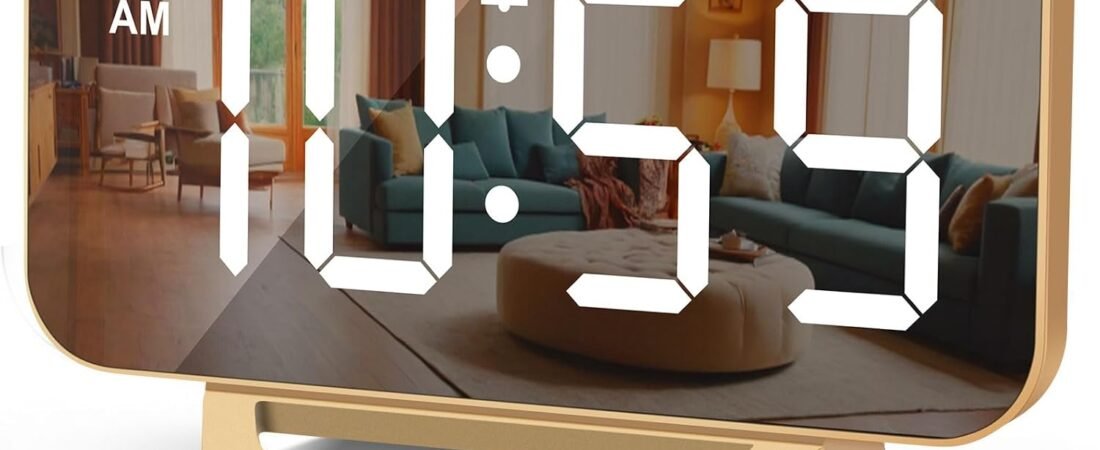
A bedside alarm clock can be a surprisingly useful part of a bedroom setup. While smartphones have made it easy to check the time and set alarms, keeping a dedicated clock nearby can provide a simpler alternative for people who prefer not to rely on their phone for every basic task. A well-designed digital clock can also become part of the room’s visual style rather than simply functioning as a piece of electronic equipment.
The Peakeep Slim Digital Mirror Aesthetic Alarm Clock combines digital timekeeping with a mirror-style front and a slim design intended for bedrooms, desks, nightstands, and other small spaces. Its aesthetic appearance makes it relevant not only as an alarm clock but also as a decorative element that can fit into contemporary room arrangements.
A mirror-style digital clock can serve several purposes. It can provide a visible time display from across a room, act as an alarm for waking up, and contribute to a tidy bedside or desktop arrangement. The reflective surface can also make the clock blend more naturally with modern decor than a conventional plastic alarm clock.
At the same time, choosing a digital alarm clock requires more than looking at its appearance. Users should consider display visibility, placement, alarm settings, power requirements, brightness, room lighting, and how the clock fits into their daily routine.
This guide explores the practical role of the Peakeep Slim Digital Mirror Alarm Clock, including its design characteristics, possible uses, setup considerations, comparisons with other types of clocks, and questions users may have before incorporating one into a bedroom or workspace.
Understanding the Peakeep Slim Digital Mirror Alarm Clock
The Peakeep clock is designed around a simple concept: combine an electronic time display with a mirror-inspired aesthetic.
Traditional alarm clocks often have a dedicated clock-like appearance, while smartphone alarms are integrated into a device that performs dozens of other functions. A mirror-style digital alarm clock sits somewhere between those approaches.
It is a dedicated timekeeping device that can remain on a bedside table or desk. At the same time, its appearance can contribute to the overall look of the space.
This can be particularly useful for people who pay attention to bedroom or workspace organization. Instead of adding another visually dominant electronic device, a slim clock can occupy a relatively small area while providing a clearly defined function.
The clock’s usefulness ultimately depends on how it is positioned, how easy the display is to read in the intended environment, and whether its alarm and timekeeping functions match the user’s routine.
Key Features and Design Characteristics
Slim Profile for Small Spaces
One of the main ideas behind a slim digital alarm clock is efficient use of surface space.
A nightstand can quickly become crowded with lamps, charging cables, books, glasses, water bottles, and personal items. A large alarm clock can add to that clutter.
A slim clock can provide dedicated timekeeping without requiring a large footprint.
The same principle applies to desks.
A workspace may already contain a monitor, keyboard, speakers, notebooks, a phone, and other accessories. A compact clock can fit into an available corner without becoming the main focus of the desk.
The exact dimensions and placement should still be checked against the user’s available space.
A clock that looks compact in photographs can occupy more room than expected when combined with a charging cable or other accessories.
Mirror-Style Digital Display
The mirror-inspired surface is one of the defining visual characteristics of this type of alarm clock.
A mirror clock can create a different visual effect from a conventional digital display. When the display is inactive or viewed from certain angles, the reflective surface can blend into the surrounding environment.
When the time is displayed, the illuminated digits become the primary information.
This combination makes the clock suitable for rooms where appearance matters.
For example, a bedroom with minimalist furniture, neutral colors, modern accessories, or vanity-style decor may benefit from a clock that feels more like part of the decor.
The reflective surface also means that ambient lighting can affect how the clock looks. Direct sunlight, strong lamps, or reflections from windows can influence visibility.
Placement therefore matters.
Digital Timekeeping
The primary function remains straightforward: displaying the current time.
A dedicated digital clock has an advantage over a smartphone in one specific respect. The time is always associated with the clock’s primary purpose.
Users do not need to unlock a phone, navigate around notifications, or open an application simply to determine the current time.
This can be particularly useful at night.
A person waking briefly may prefer to glance toward a bedside clock instead of picking up a smartphone and potentially becoming distracted by messages, social media, or other notifications.
Alarm Function
An alarm clock’s most important practical feature is its ability to provide an audible wake-up reminder.
A dedicated alarm can be useful for people who want a separate device for waking up rather than relying entirely on a smartphone.
The exact alarm configuration, controls, sound behavior, and available settings should be verified against the current product documentation.
Users should also test the alarm after setup.
A simple test can confirm that the selected alarm time, volume, and settings behave as expected before the clock is relied upon for an important appointment.
Aesthetic Bedroom Decor
The design of an alarm clock can influence how it fits into a room.
A mirror-style surface can complement bedroom furniture, dressing tables, office desks, shelves, and modern decor.
This is particularly relevant for people who prefer practical objects that also contribute to the visual organization of a room.
Instead of treating the clock as a purely functional appliance, it can become part of the room’s overall arrangement.
The aesthetic benefit is subjective, however. Different interior styles call for different materials, colors, shapes, and finishes.
A mirror-style design may fit well with contemporary decor but may be less appropriate for someone who prefers rustic, traditional, or industrial furniture.
How the Peakeep Digital Mirror Clock Can Be Used
As a Bedside Alarm Clock
The most obvious application is the bedroom nightstand.
Placed next to the bed, the clock provides a dedicated location for checking the time and setting an alarm.
This can be useful for people who want to keep their smartphone farther away while sleeping.
For example, instead of keeping a phone directly beside the pillow, a user can place the phone elsewhere and use the dedicated alarm clock for waking up.
This arrangement can also reduce the temptation to check notifications immediately before going to sleep or immediately after waking.
The clock does not need to replace every function of a smartphone. It simply takes over one specific task: timekeeping and waking.
As a Desk Clock
The clock can also be used on a work or study desk.
Having the time visible without checking a phone can make it easier to remain focused.
Students can use a desk clock while studying, while remote workers can keep track of the time during meetings, work blocks, or scheduled breaks.
A dedicated clock can also help establish a simple work rhythm.
For example, a person may choose to work for a set period and then take a short break based on the clock rather than constantly checking a smartphone.
On a Vanity or Dressing Table
The mirror-style appearance makes this category of clock particularly relevant to vanity areas.
A dressing table often already contains mirrors, cosmetics, grooming products, jewelry, and lighting.
A digital mirror clock can complement that environment while providing a clear time reference.
The reflective design may also visually blend into the area instead of appearing like a separate piece of office equipment.
In a Dorm Room
Students often have limited space.
A dorm room may combine sleeping, studying, storage, and personal activities within a relatively small area.
A slim digital alarm clock can serve as a compact bedside and study accessory.
It can also reduce dependence on a phone alarm, particularly for students who want to keep their phone away from the bed.
Because dorm environments can vary considerably, users should consider whether the clock’s power requirements and physical placement are compatible with the available outlet and desk space.
In a Home Office
A home office benefits from clear time awareness.
A desk clock can provide an unobtrusive reference point during work sessions without adding another application or screen to a computer.
This can be especially useful when the computer already contains numerous notifications.
The clock provides one simple piece of information without requiring additional software.
In a Guest Room
A dedicated alarm clock can make a guest room more convenient.
Visitors may not know where clocks are located or may prefer not to rely on their own phone.
A bedside clock can provide a familiar reference point and allow guests to set an alarm without needing access to another device.
This is a small addition, but it can make a guest bedroom feel more intentionally equipped.
In a Teenager’s Bedroom
A dedicated alarm clock can also help teenagers establish independent routines.
Instead of relying exclusively on a smartphone for waking up, a teenager can use a separate alarm device.
This can be useful for school mornings, extracurricular activities, or early appointments.
The visual design may also appeal to users who want their bedroom accessories to look modern rather than purely functional.
Why a Dedicated Alarm Clock Can Still Be Useful
Smartphones have largely replaced alarm clocks for many people, but that does not make dedicated clocks obsolete.
There is a fundamental difference between a phone and an alarm clock.
A phone is designed to attract attention through notifications, applications, communication, entertainment, and internet access.
An alarm clock has a much narrower purpose.
This can be useful at bedtime.
A person who picks up a smartphone to check the time may end up reading messages, checking social media, browsing news, or watching videos. A clock eliminates many of those distractions.
A dedicated alarm also does not depend on the phone’s battery being charged, provided the clock itself has an appropriate power source.
For people who prefer separating sleep from smartphone use, this distinction can be meaningful.
Choosing the Right Placement
Where the clock is placed can have a major impact on how useful it becomes.
Bedside Placement
For a bedside setup, the clock should be positioned where the display can be seen without requiring the user to sit upright.
At the same time, it should not be so close to the face that the display becomes unnecessarily bright during the night.
Users should consider reflections from windows, lamps, and other light sources.
Desk Placement
On a desk, the clock can be positioned beside or behind other accessories.
It should remain visible without obstructing the monitor, keyboard, or workspace.
A slight angle may improve visibility depending on the reflective surface and viewing position.
Vanity Placement
On a dressing table, the clock can be positioned beside grooming products or beneath a larger mirror.
The goal is to maintain visibility while keeping the reflective surface from becoming visually crowded.
Shelf Placement
A shelf can also work, particularly in a bedroom or living area.
However, the display should remain visible from the locations where the time is likely to be checked.
A beautiful clock that is placed behind decorative objects is less useful than a simple clock that remains clearly visible.
Who May Find This Type of Alarm Clock Suitable?
People Who Want Less Phone Use at Bedtime
A dedicated alarm clock can help separate waking and timekeeping from smartphone use.
People who prefer to leave their phone away from the bed may find this arrangement practical.
Students
Students can use a clock for both bedroom and study purposes.
The same device can provide an alarm in the morning and a visible time reference during homework or study sessions.
Remote Workers
Remote workers often spend long periods at a desk.
A dedicated clock can provide a simple time reference without requiring the user to interrupt work and check another device.
People Who Care About Interior Design
The mirror-style aesthetic may appeal to users who want practical objects to coordinate with their room decor.
Instead of looking like a conventional electronic appliance, the clock can function as part of the room’s visual arrangement.
Guest-Room Owners
A bedside alarm clock can be a useful addition to a guest room, especially when visitors may not know the layout of the house or may not want to use their phone as an alarm.
Important Things to Consider
Display Visibility Depends on Lighting
Reflective surfaces can look different under different lighting conditions.
A clock placed directly opposite a bright window may produce reflections that interfere with readability.
Likewise, strong room lighting can affect how the digits appear.
Before deciding on a permanent location, users may want to test the clock from the positions where they normally sit or lie down.
Brightness Matters at Night
A digital clock needs to be visible, but excessive brightness can be distracting in a dark bedroom.
If the model offers brightness adjustment, users should choose a setting appropriate for their sleeping environment.
A comfortable nighttime display can be different from the brightness preferred during the day.
Users should refer to the product’s current instructions for available brightness settings and controls.
Power Requirements Should Be Checked
Many slim digital alarm clocks use external power rather than operating solely from a large internal battery.
Users should verify the exact power arrangement included with the current product configuration.
Cable placement is especially important on a nightstand.
A charging or power cable that crosses a walking path or hangs loosely can become inconvenient.
The Mirror Surface Requires Cleaning
A reflective clock surface can show fingerprints, dust, and smudges more easily than a matte plastic enclosure.
Cleaning should be performed according to the manufacturer’s recommendations.
Avoid abrasive materials that could scratch the surface.
A soft, appropriate cleaning cloth is generally more suitable for delicate reflective finishes than rough paper or household cleaning tools.
Alarm Reliability Should Be Tested
Before relying on the clock for an important morning appointment, users should test the alarm.
Check the time, alarm setting, volume, and power connection.
This is especially important after changing settings or moving the clock to another location.
A short test can prevent unpleasant surprises.
Placement Near Water Should Be Avoided
An alarm clock designed for bedrooms and desks should not be treated as a bathroom appliance unless the manufacturer specifically states otherwise.
Keeping electronic equipment away from sinks, bathtubs, showers, and other sources of water is a sensible precaution.
Aesthetic Design Is Subjective
A mirror-style appearance will not appeal to everyone.
Users should consider how the reflective surface and digital digits fit with existing furniture and decor.
The visual style may work particularly well in modern, minimalist, or contemporary spaces, while other interior styles may call for a different clock design.
Comparing General Alarm Clock Categories
Mirror Digital Clock vs. Traditional Alarm Clock
Traditional alarm clocks often use physical buttons, analog hands, or a conventional digital display.
They tend to prioritize simplicity and familiarity.
A mirror digital clock places greater emphasis on contemporary appearance and a clean digital interface.
The choice depends on whether the user values traditional styling or a more modern aesthetic.
Digital Alarm Clock vs. Smartphone Alarm
A smartphone alarm has the advantage of flexibility.
Users can create multiple alarms, select different sounds, and integrate alarms with calendars or other applications.
However, smartphones also bring notifications and distractions.
A dedicated alarm clock has a much narrower purpose.
For people who want to keep their phone away from the bed, this simplicity can be useful.
Mirror Clock vs. Smart Display
Smart displays can show time, weather, calendars, reminders, and other information.
They may also respond to voice commands and integrate with smart-home systems.
A dedicated mirror alarm clock is considerably more focused.
It provides timekeeping and alarm functionality without becoming another large connected screen in the bedroom.
For users who want simplicity, that can be an advantage.
Desk Clock vs. Wall Clock
A wall clock can be seen from across a room and does not occupy desk or nightstand space.
However, it requires suitable wall placement and may not be visible from every position.
A desk or bedside clock is closer to the user and can provide more direct access to alarm controls.
Digital Alarm Clock vs. Analog Watch
An analog wristwatch can provide portable timekeeping, but it may not provide the same bedside visibility or dedicated alarm functionality.
A digital alarm clock remains in a fixed location and can serve as a consistent time reference.
These two products therefore serve different purposes rather than directly replacing one another.
Creating a More Organized Nightstand
A dedicated clock can also contribute to better organization.
Nightstands frequently become storage areas for unrelated objects.
A simple arrangement might include the clock, a lamp, a book, and a charging location for the phone.
Keeping the clock in a consistent position makes it easier to see the time without searching.
The same concept works on a desk.
Instead of placing the clock wherever there is temporary space, assigning it a permanent position can make the entire workspace feel more organized.
The mirror-style design can contribute to this effect because it can visually blend into the surrounding arrangement.
Using the Clock as Part of a Morning Routine
An alarm clock can do more than wake someone up.
It can become an anchor for a consistent morning routine.
For example, a person might set a regular alarm, get up at the same general time each day, open curtains, drink water, and begin their morning routine.
The clock provides a simple external cue.
Consistency can be useful for people who are trying to establish more structured mornings.
The important point is that the clock supports the routine rather than creating the routine itself.
Using a Desk Clock for Focused Work
Time awareness can also support focused work.
A person working from home might divide the day into blocks.
For example, a work period can be followed by a short break, lunch, and another work session.
A dedicated clock provides the time reference without requiring the user to switch between applications.
This can be especially helpful for people who find smartphone notifications distracting.
The clock does not need to be used as a productivity tool in a complicated way.
Its value can simply come from making time visible.
Frequently Asked Questions
What is the Peakeep Slim Digital Mirror Alarm Clock?
It is a compact digital alarm clock designed around a mirror-style aesthetic and intended for spaces such as bedrooms, desks, nightstands, and other indoor areas.
Can it be used as a bedside alarm clock?
Yes. Its primary purpose makes it suitable for bedside use, assuming the clock is positioned and powered according to the manufacturer’s instructions.
Can it be used on a desk?
Yes. A desk is another practical location for a compact digital clock. It can provide a visible time reference while working or studying.
Why choose a mirror-style alarm clock?
A mirror-style clock combines digital timekeeping with a reflective aesthetic that can blend into modern bedroom, vanity, or desk decor.
Is a dedicated alarm clock still useful if I have a smartphone?
It can be. A dedicated clock provides timekeeping and alarm functions without exposing the user to the notifications, applications, and distractions associated with a smartphone.
Can a mirror clock be used in a dark bedroom?
Digital clocks can generally be used in bedrooms, but the appropriate display brightness depends on the model and the user’s environment. If brightness controls are available, users can adjust them according to their preferences.
Can sunlight affect the display?
Strong ambient light and reflections can influence the visibility of reflective displays. Placement away from direct glare may improve readability.
Does a digital alarm clock replace a smartphone?
No. It performs a much narrower role. Its purpose is primarily timekeeping and alarm functionality.
Is the mirror surface difficult to maintain?
Reflective surfaces can show fingerprints and dust more readily than matte surfaces. Regular gentle cleaning using an appropriate cloth can help maintain appearance.
Can the clock be placed in a bathroom?
Users should not assume that an indoor digital alarm clock is water resistant. Unless the manufacturer specifically states that the model is suitable for bathroom environments, it is safer to keep it away from water.
Is it suitable for a dorm room?
A compact digital alarm clock can be useful in a dorm room because it can serve both bedside and study purposes while occupying relatively little surface space.
Can children use a digital alarm clock?
A digital alarm clock can be used in a child’s or teenager’s bedroom, but parents or guardians should consider the child’s age, the alarm volume, cable placement, and safe access to electrical connections.
Does the clock help reduce smartphone use?
It can support a reduced-phone bedtime routine by providing an alternative way to check the time and wake up. The effectiveness depends on how the user chooses to structure their environment.
Can it be used as a decorative object?
Yes. Its mirror-style appearance is intended to complement its functional purpose with an aesthetic role in bedroom and desk environments.
What should I consider before choosing a digital alarm clock?
Important considerations include display readability, brightness, physical dimensions, power requirements, alarm controls, placement, cleaning, and compatibility with the intended room setup.
Is a mirror-style clock suitable for every interior?
Not necessarily. Interior design preferences differ. A reflective digital design may work particularly well with contemporary or minimalist decor, while other rooms may benefit from a traditional clock.
Conclusion
The Peakeep Slim Digital Mirror Aesthetic Alarm Clock demonstrates how a simple household object can combine practical timekeeping with contemporary interior design.
Its mirror-inspired appearance allows it to function as more than a conventional alarm clock. On a bedside table, it can provide a dedicated time display and wake-up alarm. On a desk, it can serve as a simple time reference during work or study. In a vanity area or modern bedroom, the reflective design can also contribute to the surrounding decor.
One of the main reasons to consider a dedicated alarm clock is its simplicity. Unlike a smartphone, the clock is not designed around social media, messages, entertainment, or constant notifications. It can provide the specific functions needed for waking up and checking the time without requiring interaction with a multifunctional mobile device.
At the same time, the clock’s practical value depends on placement and environment. Reflections, room lighting, display brightness, power access, and viewing angle can all affect the experience. Users should also follow the manufacturer’s instructions for setup, cleaning, and electrical safety.
For students, remote workers, people creating a more organized bedroom, and anyone interested in reducing smartphone dependence around bedtime, a dedicated digital alarm clock can remain a useful addition to the home.
The mirror-style approach adds another dimension by allowing a functional device to blend more naturally with contemporary decor.
Before setting up the clock, users should check the current product instructions and specifications, particularly regarding power requirements, alarm controls, display settings, and placement.